
Table of Contents
Bridges and implants both fill a gap, but they rest on very different foundations.
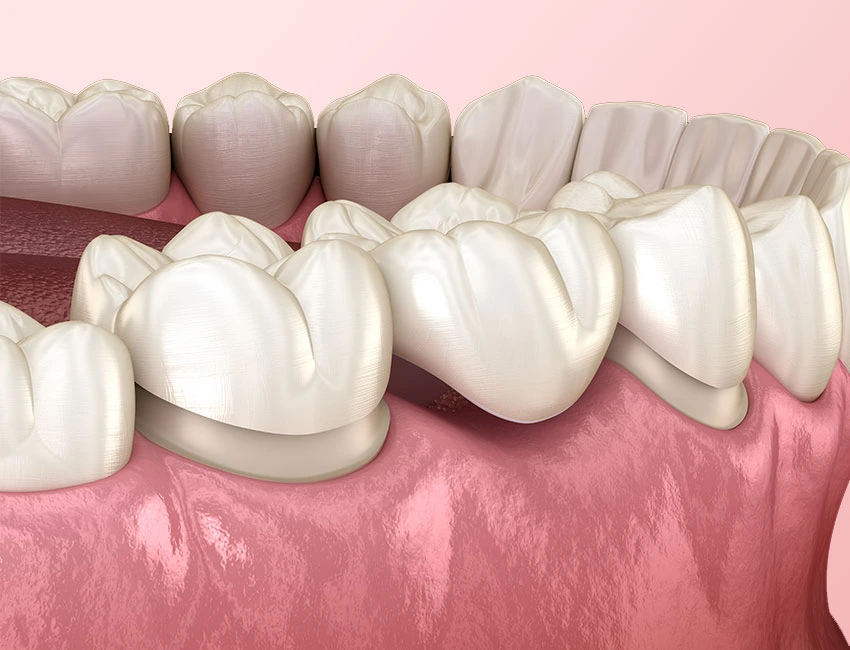
Lost a tooth and now hearing two different ways to fix it? The dental implant vs. bridge question is mostly about support. A dental bridge is a fixed row of crowns that spans the gap and rests on the teeth on either side of it.
A dental implant is a small titanium post placed in the jawbone, where it acts like a new root and holds a single crown. Both stay in your mouth full time and can look like a natural tooth.
Quick Answer
A dental implant and a bridge both replace a missing tooth with a fixed, natural-looking tooth. A bridge rests on the neighboring teeth and usually takes two visits over a few weeks. An implant stands on its own in the jawbone, leaves the neighbors alone, and takes several months. The dentist recommends one after checking the teeth and bone.
Key Takeaways
- A bridge rests on the teeth beside the gap, which are shaped to hold crowns.
- An implant replaces the missing root with a post that bonds with the jawbone over time.
- A bridge usually finishes within a few weeks, while an implant takes several months to complete.
- The health of the neighboring teeth and the jawbone guides which option the dentist recommends.
- Dental insurance is more likely to cover part of a bridge than part of an implant.
How Does a Dental Bridge Replace a Tooth?
A bridge uses the teeth next to the gap as anchors. In a traditional bridge, the dentist shapes those two teeth, and a lab makes one piece with a crown for each anchor and a replacement tooth in between.
Other designs suit other situations. A cantilever bridge anchors to a tooth on one side only. A Maryland bridge bonds small wings to the backs of the neighboring teeth, and an implant bridge rests on implants to replace several teeth in a row.
How Does a Dental Implant Replace a Tooth?
An implant replaces the root as well as the visible tooth. A dentist or oral surgeon places a titanium post in the jawbone, and the bone grows around it during healing.
Once the post is stable, a connector called an abutment goes on top, followed by a crown. An implant needs enough bone to hold it. When the bone has thinned after a tooth loss, a bone graft can rebuild the area before the implant goes in.
How Long Does Each Option Take?
A bridge is the shorter path. According to Healthline, a bridge usually needs two visits spread over a couple of weeks, while the implant process can take up to six months.
Most of the implant timeline is healing time, as the bone fuses with the post, and a bone graft adds its own healing time. With a bridge, a temporary covers the shaped teeth between visits.
What Happens to the Neighboring Teeth?
A traditional bridge changes the teeth next to the gap, because they’re reshaped to fit under crowns. That trade feels fair when those teeth already have large fillings or old crowns. It feels like a bigger cost when they’re healthy and untouched.
An implant stands alone, so the teeth on either side stay as they are. A Maryland bridge sits in between, since its wings bond to the backs of the neighbors with very little shaping.
How Long Does Each One Last?
A well-cared-for bridge lasts about 5 to 15 years, and daily cleaning under the replacement tooth helps it reach the top of that range. Healthline notes that implants can last 15 years or more.
Both depend on the same habits. Brushing twice a day, cleaning between teeth and regular dental cleanings keep the gums healthy around either one.
Dental Implant vs. Bridge: When Does Each Make Sense?
The dentist looks at the gap, the neighbors and the bone before recommending a plan. A bridge often makes sense when the neighboring teeth already need crowns, when someone’s health makes surgery a poor fit, or when a faster result matters.
An implant often makes sense when the neighboring teeth are healthy and there’s enough bone to hold a post. X-rays show the bone, and the exam shows the condition of the teeth around the gap.
Frequently Asked Questions
Is a dental implant or a bridge cheaper?
A bridge usually costs less up front than an implant, and insurance is more likely to cover part of it. An implant can cost less over many years when it outlasts a bridge that would need replacing.
Can you get a bridge for a front tooth?
Yes, a bridge can replace a missing front tooth. Ceramic and zirconia bridges give a fully tooth-colored result matched to the teeth beside it.
What happens if you leave a gap from a missing tooth?
The teeth next to an open space tend to tilt or drift into it, which changes the bite and makes those areas harder to clean. The jawbone under the gap also shrinks over time, which can make a later implant harder to place.
Two Good Ways to Fill One Gap
A dental bridge and an implant each give back a fixed tooth that looks natural and lets you chew normally. The bridge is faster and leans on its neighbors, while the implant takes longer and stands on its own in the bone. The condition of the teeth and bone around the gap decides which one fits best.
Related Reading
- Tooth Extraction vs. Saving the Tooth: How Do Dentists Decide?
- Which Dental Restoration Procedure Is Right for You?
About the Author
Dr. Ali Dabirian, DDS, graduated from NYU College of Dentistry and practices dentistry at Canyon Country Dental Care. He is a member of the American Dental Association, California Dental Association and Academy of General Dentistry.
- If you want to learn more about replacing a missing tooth, visit our Dental Bridge in Canyon Country, CA page or schedule a consultation.